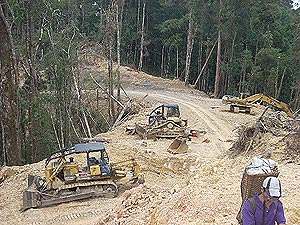
Anembiak Latong Rebak Baru

Tabi Basa ngagai semua temuai..... Aku siko ari anembiak dayak rebak baru, ti deka mai semua dayak kemaia ari berunding bakani cara kitai dayak ulih sama taraf enggau bangsa bukai. Kediatu anang kitai silap, bangsa dayak agi tinggal laban bangsa bukai (Cina & Melayu). Ukai salah cina ukai salah laut, laban sida iya maju tegal tuai sida iya perihatin, tegal tuai sida bisi tanggung jawap nyadi pemimpin bangsa sida. Anang nyima ati meda sida maju, tang meh tau nyadi ke chuan teladan kitai dayak ngambi ke kitai "move forward" lalu ulih sama penuduk enggau sida. Piak mega tuai kitai dayak patut berunding bakani cara deka ngangkat ke martabat bangsa diri ari segi ekonomi, kelebih agi ba bangsa dayak dalam bidang "PERTANIAN" enggau cara komersial ti tau ngenatai ke hasil ngagai bangsa dayak tiap bulan. Awak ke bangsa dayak enda suntuk, ulih nyengula ke anak sampai ke peringkat ke tinggi. Ukai enggau mai kompeni besai ngereja tanah dayak enggau tuju "DEVELOPMENT" tauka "PEMANSANG". Nadai maioh dayak untung laban pemansang ti bakanya, laban aku kala meda penyampau terima sida. Kemanah agi tulung dayak ngepun ke dagang sida enggau cara bekebun cara komersial, nya baru project @ pemansang ke amat-amat ulih nulung bangsa iban menua pesisir. Arap ke bala kitai ke anembiak baru ulih enchelak enda agi tinggal penemu terpawah runding baka sida ke tuai kelia. Ukai mai nanah ke pembangkang tauka perintah, ukai mai ngelaban pembangkang tauka perintah. Tang meh mai ngiga jalai mansut ke dayak ari belenggu "KEMISKINAN" tauka ari penyuntuk. Udah kitai dayak ulih niri, negi ke ladang tauka kebun cara komersial ila baru kitai sedar nama reti project atap zink, project jelatung, project nyemin luar jalai rumah. Ukai mantah project, mai kita semua berati ke iya. Lalu kepenudi iya, aram meh kitai dayak rebak baru bela seati. Bela narit bala kitai dayak keluar ari belenggu penyuntuk ngambi ke ulih sama penuduk enggau bangsa bukai. Anembiak Latong Rebak Baru stanleymethew@yahoo.com +60198397752

Saturday, February 26, 2011

Another Leaf Turn In NCR Case

Another Leaf turn In NCR Case


The ongoing native land case has taken another turn with one of those sued naming the lawyer responsible for preparing and witnessing a so-called “Deed of Settlement and Undertaking” between the claimants and the contractor.

The legal battle is between logging contractor Loyal Billion, representing timber licensee Quality Concrete and co-defendant Penghulu Merum Babu in the heated Native Customary Rights (NCR) land case. Loyal Billion named the counsel as Arthur Lee Cheng Chuan.

The ‘deed’, dated last Aug 30, states that local Iban NCR landowners had sold off their land rights for only RM250 per family. Iban villagers from 15 longhouses have denied knowledge of this ‘deed’.

They had lodged 23 police reports on Feb 19, claiming fraud, misrepresentation and cheating in the signing of the Deed.

Another 37 villagers lodged similar police reports in Simunjan on Feb 23 and 24, with more expected when remote villagers reach downriver Simunjan.

These villagers have been blockading the timber access road against Loyal Billion, logging contractor for Quality Concrete Holdings, the holder of the logging licence. Quality Concrete’s significant shareholders include the Sarawak Chief Minister’s family members, his sister Raziah and cousin Hamed Sepawi, among others.

They have moved from the blockade in the hills to the courtroom, claiming the loggers had encroached on their ancestral land. They filed a suit last November in the Kuching High Court, naming Quality Concrete and Loyal Billion as defendants, as well as an Iban Penghulu Merum Babu, another Iban individual, and the Sarawak government.

The communities’ legal action followed unsuccessful appeals to the authorities to protect their land against the loggers.

Numpang Suntai, the lead plaintiff in the civil suit, was later charged with criminal intimidation of Loyal Billion, following the villagers’ blockade of the logging road.

The High Court had granted an interim injunction against the companies on Jan 27, restraining them from logging or working on the contested land.

“Publicity campaign” charge

Tang and Partners Advocates, the legal firm representing the first, second and third defendants – Quality Concrete, Loyal Billion and Penghulu Merum Babu respectively – first presented the contentious ‘Deed of Settlement’ as a court document on Feb 16, arguing the natives had willingly signed away their NCR land.

Loyal Billion director Lau Pong Hui and Pengulu Merum Babu in new affidavits on Feb 21 affirmed that, as advised by their lawyers, they “verily believe that the Deed of Settlement and Undertaking dated 30 August 2010… which was prepared by Mr Arthur Lee Cheng Chuan, an advocate of Messrs Arthur Lee Lin & Co Advocates, is good, proper, lawful and valid in law.”

They also “aver that Mr Arthur Lee Cheng Chuan was a witness to the signatures of the directors of the second Defendant and to the signature of Penghulu of Sungai Sebangan, i.e. Penghulu Merum Babu.”

In the same affidavits by Lau and Penghulu Merum, they argued that “the lodging of police reports by this handful…of 24 persons at this eleventh hour which received a great deal of and widespread media coverage is a publicity campaign to capitalise (on) the NCR issues before the upcoming state election.” Lau’s affidavit included news clipping of three local Chinese Newspapers.

Lau’s and Penghulu Merum’s insinuation of the police reports being a “publicity campaign” appears to have been directed at counsel for the plaintiffs, See Chee How of Messrs Baru Bian Advocates and Solicitors.

Both Baru Bian (right) and See are state PKR leaders, and have been practising as renowned NCR land rights lawyers for over a decade, regardless of any elections.

The villagers said that the first they had heard of the so-called Deed was when the defendants’ lawyer tendered the documents in court on Feb 16, the date when Numpang and the plaintiffs’ counsel were attending to the start of the ‘criminal intimidation’ trial at Simunjan, some two hours’ drive away from Kuching.

The villagers then lodged their police reports on Feb 19, as soon as they had discovered that they were supposed to have signed a deed that sold off their NCR land for only RM250 per family.

“The company’s affidavit claims the lawsuit was politically motivated,” said Numpang, lead plaintiff in the High Court suit.

“Let’s look at this logic. Let’s say you are a victim of cheating, misrepresentation and fraud, and you are supposed to have given up land rights inherited through generations for a measly RM250 per family.

“Does this mean you must not fight for your rights when there is an election around the corner? There is nothing for us to apologise in defending our rights.” concluded Numpang.

The Kuching High Court had set today, Feb 25 for filing of all affidavits, with final submissions by all parties on March 2 for the court’s final decision on March 4 whether the interim injunction will be extended until the conclusion of the NCR land case.

Ulu Niah - Bala Samseng (Apek Bayat) ke dianjung BLD Company Resources

Anembiak Latong Rebak Baru

Ulu Niah- 100iko bala apek bayat ke dianjung siti ari kompeni kelapa sawit (BLD) ka bisi penanggol enggau dua buah rumah panjai, Rh. Ranggong enggau Rumah Belilie datai ngagai letan tanah NCR sida menuanya bebai ka senjata, enggau bom (explosive) dikena sida ngenakut ke bala dua buah rumah panjai nya.
Tuai Apek Bayat Ditangkap Polis

Apek Bayat bangsa iban ke mina nerima bayar RM100 ari company

Bom (Explosive) ke dibai

Beduduk ari tu diak kitai dayak sama nemu pemendar-mendar company serta orang bukai ka ngambi tanah adat kitai baka ke nyadi di Niah tu. Nyau sampai bebai ke senjata kena bebunuh.

Pia mega bala apek bayat tu ngaga langkau (Khemah) ba semak enggau tanah NCR dua buah rumah panjai tu,serta tuju sida tu endang sigi deka nyerang sida dua buah rumah panjai tu.

Khemah alai bala apek bayat

Kompeni BLD tu patut diukum berat ari segi undang-undang, laban ti beguna ke samseng ngeremba orang rumah panjai pia mega bebai ke senjata ti ulih ngenatai ke penusah (Bom/Explosive. Tang nama kebuah mina ketuai samseng aja ti ditangkap tang bala iya bukai diasuh pulai pia aja?
Bakatu meh gaya company, laban ngasai diri kaya bisi duit sepeneka ati deka ngereja tanah adat kitai dayak. Pia mega sida kebisi kaul enggau orang pemesai.
Endang sigi disadang ti sema sida majak beguna ka bala apek bayat mejal bangsa dayak nyerah ke tanah, bisi maia iya ila utai kenyadi di Ulu niah taun 1999 tau nyadi baru. Pia mega ngagai bala apek bayat iban, pikir-pikir meh dulu sebedau nulung bangsa bukai ngerompak tanah dayak.

Ngagai bala sida Rumah Ranggong & Rumah Belilie terus ke ngelaban sida ke deka ngerampas tanah kita. Anang kiruh takut ke apek bayat, takut ke keremba sida. All the best, no pain,no gain....


Anembiak Latong Rebak Baru

Friday, February 25, 2011

Native accuse newspaper of telling Lies

Natives accuse newspaper of telling lies

Anembiak Latong rebak Baru

Increasing cases of armed gangster attacks on natives over land disputes is worrying Sarawak PKR.

KUCHING: Angry residents of Rumah Ranggong in Ulu Niah, who were harassed by armed thugs last week over their native customary rights (NCR) land, have accused a local newspaper of “spinning lies” and portraying them as the “aggressors” in the incident.

The newspaper report headlined “Police finally move to diffuse standoff” allegedly stated that it was the natives who had threatened oil palm company BLD Resources with the use of force.

The report also claimed that the longhouse residents were taking over the BLD estate, illegally harvesting oil palm fruits along the roadside and had seized three tractors in order to harvest more fruits.

The report also claimed that the villagers had allegedly threatened the workers of the company with bodily harm if the company continued to lodge police reports.

Longhouse Security and Development Committee (JKKK) chairman Changgai Anak Dali in a statement condemned the report, calling it a “blatant lie”.

“We want to put the story right. We never seized any tractor… we did not threaten the company.

“It is the company that brought along gangsters who were fully armed with machetes and explosives to intimidate and threaten our people,” Changgai said.

Both BLD Resources and the newspaper are allegedly owned by one Henry Lau.

Land dispute

Changgai said the newspaper report also lied when it said that the longhouse residents, through their trustees, had signed an indemnity with the company for 30% equity in July 2009 when the joint-venture (JV) agreement between BLD, Sarawak Land Development Board (SLDB) and the native landowners of Rumah Ranggong and Rumah Belilie was signed in February 2001.

Explaining the history behind the dispute, Changgai said: “In October 2008, a deed of rescission was signed between SLDB and BLD without our knowledge to rescind the JV agreement because the state government made a mistake in declaring our NCR land as state land.

“Because of this, I was sued by BLD for trespassing on my own land and this triggered our land dispute. We filed a counter suit which is now being heard at the Kuching High Court.

“Last year, we wrote a letter to BLD to demand our land back and also to settle our long overdue dividends from the project, but we received no response. This is when we decided to erect our blockade in January this year.”

He said that the neighbouring residents of Rumah Belilie also erected a blockade to protect against BLD.

Last Friday, about 100 armed gangsters reportedly went to the outskirts of Rumah Ranggong’s NCR boundary and made camps there in an attempt to intimidate the villagers.

A gang leader was arrested and the rest were asked to leave the place by the police.

Increasing cases

Meanwhile, Sarawak PKR chairman Baru Bian has expressed concern over the use of gangsters by certain companies to harass and intimidate natives.

“There were two very disturbing incidents last week – one in Meluan where a father and son were battered by gangsters in the area and the second one about Rumah Ranggong and Rumah Belilie last Saturday.

“In the second incident, it is disturbing to note that dangerous explosives were used. These were left on the ground by the gangsters. Police arrested the leader.

“But in the Meluan incident, so far no gangsters have been arrested and ironically the father and son who were battered were arrested,” said Bian, a prominent NCR lawyer.

Bian urged the police to take the cases seriously.

“We plead with the police to take these cases seriously and to carry out their investigations promptly.

“I urge the police to be neutral in carrying out their duties as they are the guardians of the people,” he said.

He added that there had been cases where police had been against the natives.

“Two months ago, we won a case in Kapit against wrongful arrest. There are a few more cases including one pending in Miri against unlawful arrest,” he said.

Taken from Free Malaysia Today.

Bashed by Logger, Remanded by Police

Bashed by loggers, remanded by police.


A routine check for illegal logging by a Sarawak NCR landowner landed him in police custody.

SARIKEI: Minggat anak Nyakin, who has a parcel of NCR land at Sungai Rotan and Sungai Penyaru Kuba (Kiba) Sarikei, found out the hard and painful way that standing up for his rights is no easy task and could cost him his life.

Lying in Sarekei Hospital after being viciously attacked while checking on alleged illegal logging activity on his NCR land, Mingat has to now deal with being under police remand for trespassing.

Said Ngumbang Anak Barau of the Tahabas (native landowners Network): “Not only was he (Mingat) badly beaten up, he was also arrested by the police.

“Mingat and his son Juan went to their land to check on illegal logging. When they found out there was still logging going on, they tried to talk to the manager but instead were attacked.”

According to Ngumbang, the incident occurred on Feb 14.

In December 2010, Mingat reported alleged illegal logging over his land to the police, the Land and Survey Department as well as the Public Works Department and called for an investigation.

On the day of the incident, Mingat and Juan had decided to check on the situation. Upon finding continued logging activity, they decided to drop in at the log-pond and tried negotiating for compensation with its manager.

The negotiation went sour and before Minggat and his son could leave the office building, they were attacked viciously at its footsteps.

“Although badly hurt, his son managed to escape in the darkness towards a nearby oil palm plantation, while his father was left in an unconscious state at the footsteps of the log-pond manager’s office.

“Regardless of any wrongdoings or crimes that Minggat or his son may have committed, the source of the problem has yet to be investigated satisfactorily by the authorities.

“Minggat’s family agrees that Minggat should be fairly investigated, and so does the timber company that has been operating for many years on NCR lands allegedly without a relevant or valid licence.

“The alleged illegal logging seems to be proceeding unhindered thus far.

“A police report has been lodged by Minggat’s wife on Feb 16 regarding the attack. The attackers have not been arrested,” he said.

“The name of the timber company which owns the log-pond remains unknown to the rest of us, while there is no telling when investigations will be made on Minggat and his son’s attackers.

“What is certain is that Minggat and Juan will remain hospitalised for a few more days or even weeks.

“Today, their pains are too debilitating for them to even ponder what they will do next.” Ngumbang added.

Friday, February 18, 2011

Tanah Adat Bansa Dayak (NCR)

Pengawa Besukat Ketanah Adat enggau Penanggul

Kena 19th Dec 2011, tu kemari Borneo Post Online bisi ngayan ke berita bekaul enggau pekara besukat ke tanah Adat Bansa Asal (NCR).Ti bisi nyebut dikembuan kurang lebih 3,329 iko bansa Kayan,Kenyah (Dayak)di Long Aton,Tinjar enggau pemesai 1,207 hektar.Pemesai tanah enggau survey (JTS) madah deka besukat ke tanah Adat Bansa Dayak ngena cara Inisiatif Baru NCR.

Nemunya bakani ko gaya iya diatu, sekali ke udah di sukat tauka agi benung dalam "proses"? Sama-sama meh kitai ninga,serta berati ke bakani ko pengujung pengawa tu ila. Arap-arap ke mujur meh.

Tang bakani ko enggi bala kami di menua Kanowit, kelebih agi area Machan?
Puas endar ga bala sida ketuai,pia mega bala ke nemu senentang pekara tu nganjung "proposal" tauka peminta nyukat tanah tang lalu apin bisi saut jauh ke disukat. KDC nyau ka tiap taun ga minta bayar cukai pintu,cukai rumah. Kapa ga nya ukai nya maioh ga cukai dipinta sida, tang aku agi enda entu nemu nama tuju cukai enti sema rumah kitai agi beduduk ba tanah ke empai bisi permit taja pan nya tanah kitai empu, tau dikumbai tanah haram.
Ribu iya hektar sema jako tanah pelilih Machan, nama kebuah mina tanah cina aja bisi geran,bisi pala?? Tanah cina tengah-tengah tanah iban tau bisi pala,bisi permit tang belabuh ari kanowit ke Machan nyau ka semua tanah iban, maioh agi ke nadai permit,nadai pala.? Ukai nyalah cina, anang saru. Tang meh alit ati enggau utai ke nyadi,enggau permit ke dikeluar ka Land & survey.

Pia mega taun nyin kemari,maioh bala tekenyit ati. Laban bisi raban ari Kuching/semenanjung minta anjung meresa tanah sida tungga ke menua Ulu Latong nengah jala Camp Batang Ng. Machan. Kati ko sida tu tau ngumbai diri bisi tanah ke ulu Latong, nyau empega/seredah tang meh anang saru laban utai tu amat nyadi. Enda nemu kemaia tang sigi datai serta mai penanggul ngagai bala kaban belaian ke bisi dunya menua di Ulu Latong. Kati ko Titanium serta bisi dua tiga iti company tau bisi area ke Ulu Latong (ditemu dalam Map). Kemaia aki ine sida enggau berimba dunya menua kin? Ari ni sida tu bulih pemendar?

Ngelamatu Tanah Adat Bansa Dayak Mina di tanda ka ngena sungai,munggu, tinting. Tang diatu, kemanah agi ti ulih baum meh kitai nganjung peminta bebala maioh minta nyukat tanah adat kitai ngambi ke bisi bukti nya endang enggi kitai serta enda mudah dirompak,dirampas orang ngapa.

"Nothing can be done by talk,unless we effort to do it with find out the solution and then plan how we sorted this such of thing.We're not cheat anybody,we're not rob anybody,we're not grab land those belong to somebody but we're try to protect our own land."


Nya alai ngagai bala kaban belaian ari Latong ke bisi Macha artikel aku ditu arap ke kita tau ngadang-ngadang meh. Kada ke empai laun,kada ke empai nyadi manah agi kitai sedia dulu.

By: Anembiak Latong Rebak Baru.

Native Customary Rights (NCR) Over Land In Sarawak

Let share this:
1
NATIVE CUSTOMARY RIGHST (NCR) OVER LAND IN SARAWAK, MALAYSIA
By Baru Bian
Advocate & Solicitor
High Court, of Sarawak & Sabah
MALAYSIA
1. Native Customary Right (NCR), legal definition and recognition.
Native Customary Right (NCR) is not defined in the present Land Code (Cap. 81) 1958,Sarawak, (hereinafter referred to as the “Code”) but Native Customary Land is. Section 2 of the Code defines Native Customary Land (NCL) to mean:
(a) land in which native customary rights, whether communal or otherwise,
have lawfully been created prior to the 1st day of January 1958 and still
subsist as such;
(b) land from time to time comprised in a reserve to which section 6 applies;
and
(c) Interior Area Land upon which native customary rights have been
lawfully created pursuant to a permit under section 10.

The definition under (b) and (c) is not an issue and will not be elaborated in this paper. Suffice it is to state that under (b) above, it is an area of land gazetted by the Minister under section 6 of the
Code as Native Communal Reserves for a specific native community with certain guidelines as how the said community would exercise their rights therein. Once created, it will not be disputed as it has been gazetetd accordingly. Under (c) above, the Natives could only occupy Interior Area
Land upon the issuance to him of a valid permit by the Superintendent of Lands and Surveys pursuant to section 10 of the Code. This is not an issue because once a permit is granted; no one can dispute the occupation of such land by a native. What had become a hotly debated issue
through the years is the definition under (a) above i.e. “land in which native customary rights,whether communal or otherwise, have lawfully been created prior to the 1st day of January 1958 and still subsist as such”.

The definition (a) expressly provides two main criteria:

i. That it states a cut-off point by which a native has to prove the creation of NCR; i.e.before the 1st day of January 1958. (If a native creates NCR over land after 1958, itmust be with a permit under section 10, as provided for under section 5 of the Code).
ii. That the said NCR Land can be created and therefore claimed by a community or an individual.
iii. That it subsists as such until today.

Section 5, of the Code states six methods by which NCR can be created after 1st January 1958:
(a) the felling of virgin jungle and the occupation of the land thereby created;
(b) the planting of land with fruit trees;
(c) the occupation or cultivation of land;
(d) the use of land for a burial ground or shrine;
(e) the use of land of any class for rights of way; or
(f) any other lawful method.

Under definition (a) above, the area of land claimed as NCL usually has no title. But a native can apply for a title from the Lands and Surveys under section 18(1) of the Code if he can satisfy the Superintendent that he has occupied the said land in accordance with rights acquired by customary tenure amounting to ownership of the land for residential or agricultural purposes. A grant in perpetuity will normally be issued out to the applicant native. Section 18 states as
follows:
“18. (1) Where the Superintendent is satisfied that a native has occupied and used any area of unalienated State land in accordance with rights acquired by customary tenure amounting to ownership of the land for residential or agricultural purposes, he may, subject to section 18A, issue to the native a grant in perpetuity of that area of land free of premium rent and other charges.”


If a title is not issued out yet to a native in such a case, he is still deemed in law having the right but his position is referred to in law as a “licensee”. This is provided for under the proviso (i) to section 5 of the Code which states:

“(i) until a document of title has been issued in respect thereof, such land shall continue to be State land and any native lawfully in occupation thereof shall be deemed to hold by licence from the Government and shall not be required to pay any rent in respect thereof unless and until a document of title is issued to him.”

It must be noted here that, although a native is deemed holding on licence, his status is not as a bare licensee but his right is equivalent to having a title. He has legal rights which cannot be
taken away summarily without express provision of the law and that compensation must first be paid in the event his NCR is taken away or extinguished. The express provision of the Code pertaining to this matter is section 5(3) which states that “Any native customary rights may be
extinguished by direction issued by the Minister”. The said extinguishment shall be published in the Government gazette and one newspaper circulating in Sarawak; and exhibited at the notice board of the District Office for the area where the land, over which such rights are to be
extinguished, is situated. Within 60 days of such publication, any native having claim of NCR may filed his claim which will be determined by the Superintendent for the purpose of compensation. Any native unsatisfied with the decision of the Superintendent may request for the
matter to be referred to an arbitrator under section 212 of the Code.

Secondly, section 15 of the Code expressly provides too that “Without prejudice to sections 18 and 18A, State land shall not be alienated until all customary rights therein have been surrendered or extinguished or provision has been made for compensating the persons entitled
to such rights.”
From this section, it is also to be noted that NCR can exist on an area designated as “State Land”. This is one of the areas of great contention and misunderstanding. It is the view
of some people in the relevant authority that once an area is State Land, no NCR could exist. State Land is defined simply under section 2 of the Code as “…all land for which no document of title has been issued and all land which subsequent to the issue of a document of title may have been or may be forfeited or surrendered to or resumed by the Government,..”

The second proviso to section 5 of the Code further added that “the question whether any such right (NCR) has been acquired or has been lost or extinguished shall, save in so far as this Code
makes contrary provision, be determined by the law in force immediately prior to the 1st day of January 1958.” Although the methods of creating NCR is stated expressly under section 5 (2) of the Code as referred to earlier, those methods are not the method stated in the law in force
immediately prior to the 1st day of January 1958. Reading closely section 5(1) of the Code, those six methods appear to refer to the creation of NCR after 1st day of January 1958. The law applicable before 1st January 1958 is section 66 of the Land Settlement Ordinance 1933, where NCR is recognized in respect of:

(a) land planted with fruit trees, when the number of fruit trees amounts to twenty
and upwards to each acre;
(b) land that is in continuous occupation or has been cultivated or built on within three years;
(c) burial grounds or shrines;
(d) usual rights of way for men and animals from rivers, roads or houses to any or all of the above.

The important phrases in the above section are “land that is planted with fruit trees”, “land that is in continuous occupation” or “has been cultivated” or “built on” or “burial grounds” because these are the evidences that one must prove in NCR claim.

2. Problems Related to NCR claims

i. Although the law recognizes NCR claim by customary tenure, it throws the onus or burden on the natives to prove their claim. This can be difficult but not impossible. The difficulty arises because bulks of the NCL in Sarawak are not issued with titles. One of the main reasons given by the Government for not able to issue titles is lack of fund to survey these lands. Government publicly acknowledges that there are 1.6 million hectares of land under NCL in Sarawak, but these areas are not identified. Therefore, when loggers and planters of oil palm or trees are issued with licence or provisional leases, the Natives are at a disadvantage when faced with these loggers and planters as the natives have no
document to prove their claim of NCR.

ii. The Government’s definition and/or understanding of NCR claim is only
restricted to cultivated area or farmed area locally referred to as “temuda” which must have been cultivated or farmed before 1st January 1958. On the other hand, the natives believe that their NCR claim goes beyond their “temuda”. It includes their communal lands or territorial domain locally referred to as “pemakai menua” and the “reserved virgin forests” within their “pemakai menua” locally referred to as “pulau”. “Pulau” is preserved or reserved specifically to meet the domestic needs of the natives. Normally this is an area abundant with timber for boats, house, different kinds of fruit trees, jungle produce with medicinal value, a hunting ground, fishing ground etc to cater to their daily needs. (But see the landmark decision in Nor Nyawai’s Case discussed below 4 where “pemakai menua” and “pulau” had been declared and recognized as (NCL).

iii. Because of such different in understanding of what constitutes NCL or NCR, logging licenses and provisional leases are issued out covering “pemakai menua” and “pulau” of the natives in Sarawak. Because of this differing views, the matter always end up in Court for determination. (Since 1988 my legal firm had taken up 123 cases of NCR claims, majority of which are still pending in the High Court of Sarawak).

3 Case Laws on NCR
Nor anak Nyawai & Ors v. Borneo Pulp Plantation Sdn Bhd & Ors [2001] 2 CLJ 769.
Facts of the case

This is a representative action on behalf of an Iban longhouse in Sarawak, Malaysia who took legal action against the Defendants which includes the State Government of Sarawak over their Native Customary Land (pulau) having been included in a provisional lease (PL) granted to the 1st defendant for the planting of trees (acacia). The plaintiffs complained that their said Native Customary Land (NCL) was included in the area under the PL. The plaintiffs claimed that such inclusion of their said NCL was unlawful and illegal because no extinguishment of their NCR in
accordance with the Land Code, Sarawak was ever done. They pray for the exclusion of their said NCL from the said PL. In the trial the Court has to examine the rights (NCR) of an indigenous
Iban in relation to the lands and its resources to which they had no documentary title (NCL), and the recognition of the common law for the pre-existing righst under native or custom. The dispute
also called for a consideration of whether the various legislation throughout the period traversing the reign of the Sultan of Brunei before 1841 through to the time when Sarawak joined with the
other states to form Malaysia in 1963 had extinguished those native rights and whether those rights were ever exercised in the disputed area. Amongst other things, the defendants argued that the plaintiffs’ NCR (if any) had been eroded and/or extinguished by legislation.

• Findings of the Court
The High Court held amongst other things the followings:

i. The Ibans have a body of customs referred to as customary rights and the plaintiffs’ ancestors must have practiced the same customs as the present-day Ibans. Evidence adduced indicated that the plaintiffs’ ancestors had accessed the land for hunting,fishing, farming and collection of forest produce-all in the exercise of NCR. The
rights of an Iban arise by virtue of being a member of a community that occupies a longhouse and these rights, unless lost, pass down through the generations. The plaintiffs therefore were rightfully in possession of these rights.
ii. The very presence of a longhouse and its proximity to the disputed area, compounded by the fact that the disputed area fell within the boundaries of the longhouse, together with other evidence of communal existence render it probable and support the assertion that the plaintiffs and their ancestors had indeed accessed the disputed area
until they were prevented from doing so by the total destruction of the trees by the defendants.
iii. Customary law is a practice by habit of the people and not the dictate of the written law. All orders dating from the era of Rajah Brooke to current legislation declare in no uncertain terms the right of a native to clear virgin jungle, access the land surrounding the longhouse for cultivation, fishing, hunting and collection of jungle produce. Legislation has neither abolished nor extinguished NCR. On the contrary,
legislation has consistently recognized and honoured NCR even though it was not in written form.

The Defendants appealed against the decision of the High Court and the Court of Appeal allowed their appeal on one ground i.e that the plaintiffs failed to prove their claim of occupation over the pulau area, but affirmed the legal position as stated by the Learned trial Judge. The Plaintiffs had appealed against that decision of the Appeal Court on the finding of facts but interestingly the State Government of Sarawak did not appeal on the finding of law as stated above. As such it is submitted that what was held by the High Court Judge is the true and legal position of NCR in Sarawak today.

A month after the decision of the Court of Appeal in Nor anak Nyawai’s case supra, another decision came out from the Court appeal which followed the High Court’s Judge in Nor Nyawai’s case on the legal status of NCR and its definition in Sarawak . This is referred to as the
Madelli’s case.
The Madelli’s case was in fact a case involving a Malay person who is referred to as a native under the Constitution of Sarawak. Nevertheless the decision of Nor anak Nyawai applies. This is also true to the rest of the natives tribes in Sarawak.

• What about the Nomadic Penans?
Many people believes that, since the nomadic Penans do not farm and cultivate for a living, it is argued that they cannot claim NCR under the Land Code. It is my submission that the nomadic Penans can claim NCR under the laws of Sarawak if they can prove “occupation” of an area,
since time immemorial. At the moment there is no direct decision on this matter for the Penans, but two cases are now pending in the High Court of Sarawak, pertaining to this very issue.

4. Definition of Legality
Timber harvested by licensed person from approved areas and timber
products exported in accordance with the laws, regulations and procedures
pertaining to forestry, timber industry and trade of Malaysia.”

The above definition of legality had been proposed by the Malaysian Government through the Ministry of Plantation Industries and Commodities, at its “Consultations with Stakeholder Groups
Related to the EU FLEGT VPA Negotiations in Malaysia” meeting in Kota Kinabalu, Sabah, Malaysia on the 22nd June 2007. At this meting I proposed to include the following amendment after the word “areas”-“free from any NCR claim”. So the definition should read:

“Timber harvested by licensed person from approved areas free from any
NCR claim, and timber products exported in accordance with the laws,
regulations and procedures pertaining to forestry, timber industry and trade of Malaysia.”

My proposal was meant to high light the fact that NCR claim must be dealt with and must expressly be stated in the definition legality. Because NCR over land in Sarawak is recognized under the laws of the country and confirmed by the Courts in Malaysia, areas which become a
dispute because of NCR claim cannot in law be regarded as legal. Its legality is being questioned until a final decision is made by a competent authority no less then the High Court. This should
be the case for Sarawak, Malaysia.

Tanah Dayak Menua Pesisir

Nama Kebuah Utai Kebakatu Tau nyadi?


Dini-dini menua ke bisi alai sangkai dimenua Sarawak enda nemu nadai ga berita bekaul enggau tanah adat kitai bangsa (NCL). Pansut ba blog pasal tanah ke diambi dikena nuduk ke "Pemansang" kenu ko berita. Pia mega baka rumah Nor Anak Nyawai, nyau dirarak. Tang meh aku bisi berasai iran mimit,nama kebuah berita tu nadai nyengala pansut dalam tv? TV1,TV2 & TV3?

Mina ba dalam blog ke bisi nerang utai kenyadi bakatu. Pia mega aku alit ati, bakani ko company ti sebali ari enda temu penatai nyau tau beempu tanah serta bisi hak nuduk ke bisness ke dikumbai "PEMANSANG" ba tanah adat kitai dayak. Patut ke enda kompeni tu disalah? Tang ba penemu aku tentu iya bisi orang ngeluar ke geran tauka lisen ke sida tu, mai sida berani ngambu, berani nujah tanah bangsa kitai. Bah sapa orang tu deh?

Ti dilaban sida lalu nujuk ke surat ti ngesah ke area nya udah dibeli sida, endang milik sida. Makin ari nyau maioh amat kes ke bansa tu nyadi, kitai dayak nyau belaya enggau tanah diri empu, bechara enggau tanah diri empu ngelaban orang ke sebubu ari enda temu penatai.

Ti kitai nganjung peminta nyukat tanah, maioh amat ke dalih sida Jabatan Ukur/Land and survey. Enda ulih sukat setegal nya tanah adat, enda ulih beri permit laban tanah adat. Tang kati ko company tau bulih permit?? Nama beza sida iya enggau bangsa dayak??

Ka ngaga "PEMANSANG" ba siti-siti menua nadai salah. Endang disampi ke "PEMANSANG" datai, tang meh enggau patut. Anang kelalu enda bebasa ke bangsa dayak,anang kelalu kurang ajar enggau bangsa dayak. Ditu ukai ka be jai perintah, tang meh enda setuju enggau utai ti dikereja sida pemesai ti bekereja ba perintah. Enda besangkut paut enggau sapa-sapa ke makai suap ba dini-dini alai, tang meh anang ngambi tanah dayak sepeneka ati.Laban setegal land code ti salah guna tuai menua kitai nya meh kebendar amat ngenusah bangsa kitai dayak. Land code kena ngambi tanah kitai, udah nya diberi ngagai tauke-tauke besai,ngagai bala-bala ti bisi kaul dikena bejalai ke bisness. Tang meh kitai dayak ke be empu tanah mina pesap-pesap,mina dibayar pampas "BELAS KASIHAN" tauka "KENA NGUDAH".


Nya alai ngagai kaban bangsa dayak, berunding meh bala kitai semua bakani cara kitai deka ngetan ke tanah adat kitai ari ti diambi orang,kelebih agi bala company kaya ti deka bebuka ke ladang. Anang enda angkun ke tanah serta menua diri, anang alah laban keremba serta jako sebubu ngapa sebelah kaki lima. Kasih ke anak,uchu kitai jemah enggai ke nyadi kampar dimenua diri empu laban ti nadai setempap tanah alai beridup.
Anang nganti pagila, anang nganti ila. Mupuk meh kitai bela berunding,badu agi ngembuan ati bingking. Ngagai sida ke bisi pemandai serta bisi nemu bekaul enggau tanah NCL kitai dayak nadai salah meri penemu,lalau serta jalai ulih mutar ke penanggul ke udah lama nuntung bangsa kitai.

"Conclusion"
I’m a Dayak Iban and I have the right to vote. My vote count:-

1)My vote nominates
2)My vote pay good services;
3)My vote create opportunities and growth
4)My vote safeguard my Native Rights;
5)My vote preserved justice;
6)My vote is my future generation benefits;
7)My vote is my bond (Voice, Opportunity, Trust & Equity).


By: Anembiak Latong Rebak Baru